
Chatt Whiskey Deep Cuts: What is Single Pot Still Whiskey?
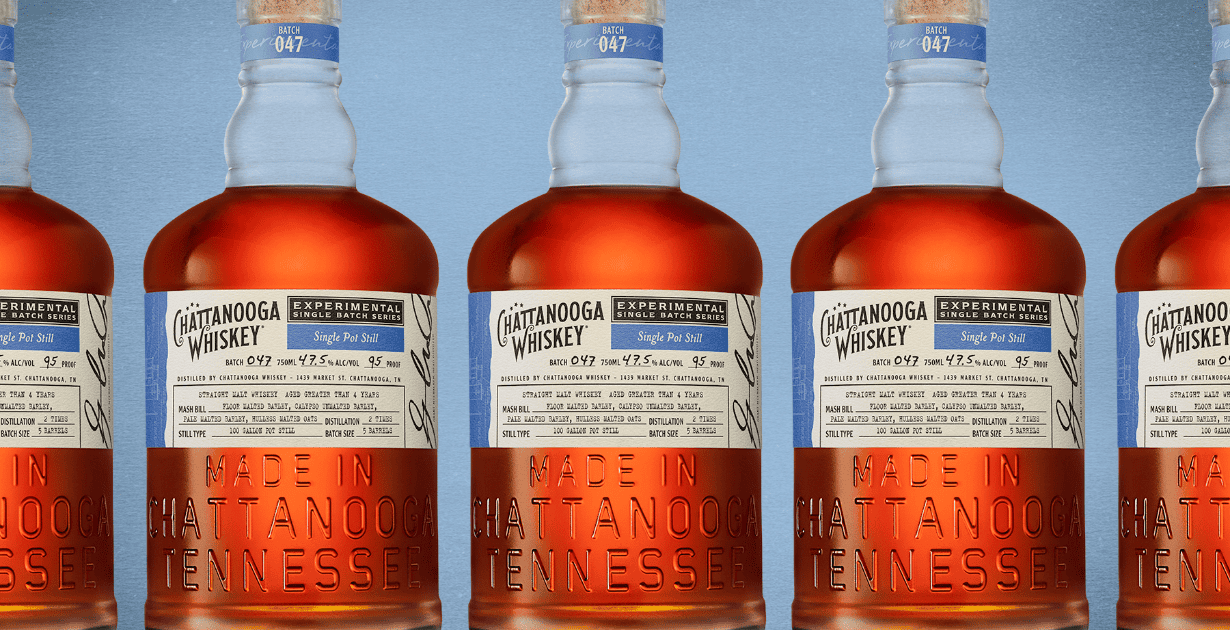
In February 2026, we released Batch 047: Single Pot Still: our small, five-barrel Experimental Batch inspired by Ireland’s most distinctive whiskey style.
Single pot still whiskey’s relatively straightforward name is from two relatively straightforward requirements: I) it’s made on a pot still and II) it’s made at a single distillery. But aside from that, what exactly makes single pot still so special…and so delicious?
Not surprisingly, it starts with the ingredients.
Famous for its inclusion of both malted barley and unmalted barley, single pot still’s flavor profile is unmistakably grain-forward. It’s thick and creamy on the palate and laced with a lively peppery spice in the finish (white pepper, ginger, clove). This character is preserved by a traditional, flavor-forward pot distillation, which allows the full flavor of these ingredients to persist within the spirit.
But before we go deeper into the ingredients and process, let’s discuss how this whiskey style became what it is today.
The History of Single Pot Still
Though single pot still has now become one of the world’s most celebrated whiskey categories, its roots are a bit more transactional than poetic. Back in 1785, King George III levied a heavy tax on malted barley in order to gather revenue from both brewers and distillers. Irish distillers responded practically, by adjusting their recipes, and using just enough malted barley to enzymatically convert the grain’s starch to sugar, and substituting the rest with untaxed raw barley. The move cut costs dramatically—and somewhat unexpectedly—birthed a richer, spicier, creamier flavor profile.
When the tax was finally repealed in 1855, single pot still had already amassed a dedicated following, and the use of raw barley stuck. From there, the style continued to flow freely into global markets for much of the 19th century. That trend continued until the mid-20th-century, when the dominance of column-distilled spirits began to take hold, tastes began to shift toward lighter blends, and America’s Prohibition began to impact Ireland’s whiskey exports.
Even after prohibition, the lull in demand persisted through the 1980s until recently when, in 2014, an Irish whiskey renaissance brought the style roaring back to prominence. Due to that resurgence, The Irish Whiskey Technical File codified rules to protect and define the style, cementing single pot still as a legally distinct and proudly Irish category:
Distilled in copper pot stills at a single distillery
At least 30% malted barley in the mash
At least 30% unmalted (raw) barley
Up to 5% other cereals (oats, rye, etc.) allowed
Distilled to no more than 94.8% ABV
Matured minimum 3 years in wooden casks (≤700 L) on the island of Ireland
Despite the many requirements that define it, two stand out above the rest: unmalted barley and pot still distillation. Unmalted barley brings the signature peppery spice and that thick, almost dairy-like mouthfeel unique to this style. Pot still distillation, in turn, preserves the grain’s bold, robust character at the forefront.
Which leads us to Chattanooga Whiskey’s version: Batch 047. For this batch, we wanted to honor every one of these traditional requirements, without straying too far from our Tennessee roots and high malt leanings.
Batch 047, from Grain-to-Glass:
Let’s start with the mash bill.
Each of Batch 047’s grains were selected to bring an authentic Irish flavor profile, yet each add characteristics unique to our Chattanooga Whiskey version.
50% Crisp No. 19 floor-malted Maris Otter — This malt is from England’s historic Great Ryburgh maltings, which—despite being bombed in 1942—was restored post-war, and has been in operation ever since. The malt is traditionally made via a slow natural-draft drying that keeps its flavor clean and bready, with a gentle sweetness that lets the barley character shine.
30% unmalted Calypso barley — This raw 2-row barley was grown close to home at Teeter Farm in Clarksville, TN. Our distillers would argue this is our pot-still hero, offering a sharp pepper mid-palate and thick, oily creaminess from its natural oils and proteins.
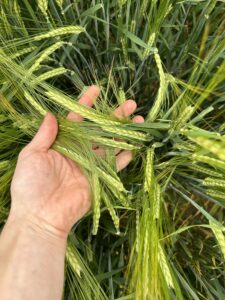
15% Gambrinus ESB malt — Made in British Columbia (Canada), this pale malt was unironically crafted to evoke a classic British malt character. This unique combination of Canadian terroir and British style delivers subtle flavors of caramel, honey, and nutty notes unlike anything found in Canada OR the UK.
5% Riverbend Streaker naked (hulless) oats — Originally developed as a high-end feed for race horses, this hulless variety has a large concentration of fatty lipids, which develop into fruity esters during the fermentation process. These fatty acids and rich flavors then survive distillation, adding silky mouthfeel and a faint nutty/almond lift that rounds out the creamy flavor profile.
Fermentation & Distillation
Like our other recipes, we fermented this recipe “low and slow” with our house “malt whiskey” yeast strain. This long fermentation allowed the yeast to run its full course and develop fruity esters from the naked oats and the spicy grain notes from the raw Calypso barley.
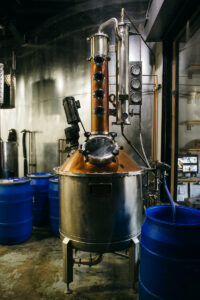
While many Irish producers triple-distill for extra refinement (lighter, more delicate fruit and floral notes), we stopped at double to hold onto more of the grain’s bold personality. This gives the spirit a fuller body, sharper spice, and that signature oily weight that makes the single pot still style so alluring.
Barrels & Aging
Unlike Irish versions, our spirit was aged within new, charred American oak barrels—a deliberate departure from typical Irish ex-bourbon and sherry casks. We specifically used a custom blend of toasts, chars, and seasonings to dial in just the right balance of wood character without overwhelming the spirit.
60% #2 char + custom P91 toast profile — The lighter #2 char (shorter burn time) and our 38-minute P91 toast (a slower, time-controlled heat profile we developed in partnership with the cooperage) gently release more vanilla, subtle caramel, honey, and soft baking spice from the wood.
20% #3 char — Medium char level adds balanced caramel, toffee, brown sugar, and a touch of earthy spice.
20% #4 char — Heavier char brings deeper vanilla, dark caramel, subtle smoke, and roasted notes for complexity and depth.
Entered into the barrel at 115 proof, the spirit seeks to extract this wide range of vanilla, toast, and seasoned oak characteristics—providing enough American depth to complement the barley without burying our Single Pot Still’s grain-forward identity.
After 4 years and 10 months in our barrelhouse, we proofed to 95—higher than most Irish expressions (usually 80–92 proof), but exactly where this mash bill sings. That higher bottling strength wakes up the peppery spice on the mid-palate while letting the long, creamy finish linger long enough to call for the next sip.
In the Glass
Toasted granola hits the palate first, evolving into baked pear and warm gingersnap cookie, before melting into a vanilla icing sweetness and a lingering, creamy finish.
Batch 047: Single Pot Still is Chattanooga Whiskey’s Tennessee tribute to Irish Whiskey: stylistically true to form, but made with local grains, double distilled on our experimental still, and aged in charred new oak.
Stop into our Experimental Distillery bottle shop to try it before it’s gone!
Sláinte!