
Behind Bad Chattanoogan: The Full Story
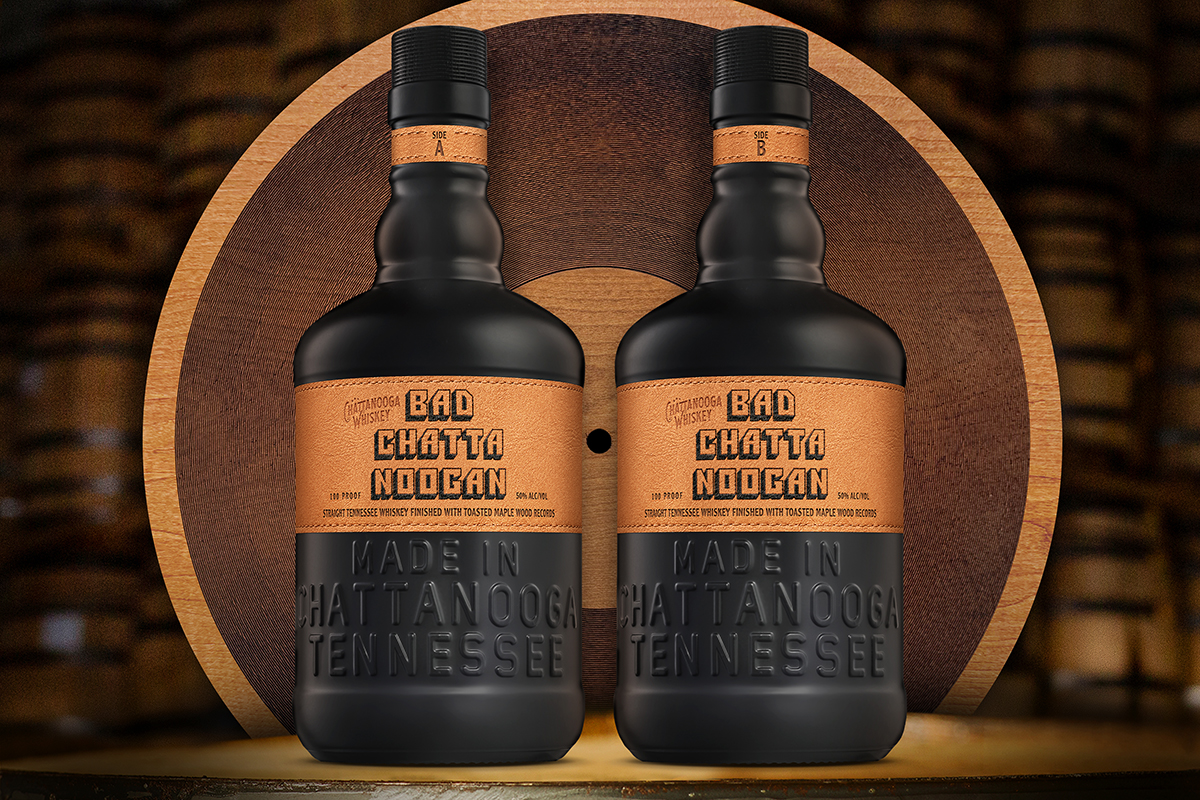
Bad Chattanoogan is believed to be the world’s first Tennessee Whiskey (or any whiskey for that matter) finished with toasted maple wood records. The records were engraved with two original tribute songs about Chattanooga, written in-house by Chattanooga Whiskey Creative Director, Rich Abercrombie, and his band Dollars Family. Unlike most music-themed whiskeys, the music didn’t just inspire this release, it literally flavored it.
The Idea
Bad Chattanoogan started with a simple idea: bring music and whiskey together in a truly unique way.
Easier said than done.
There have been a lot of music + whiskey related projects over the years, and we weren’t interested in repeating anything that someone else had already done.
At the same time that we were thinking about how to combine music and whiskey, we were developing a Tennessee Whiskey. And it started to feel like those two ideas should somehow become one…
The “aha!” moment came when we saw Independent Stave Company’s Spiral Cut barrel.
Making the Records
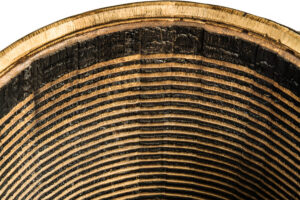
A record works on a simple, almost primitive principle: sound is a wave, and the groove on a record is that wave traced into a surface. When a needle rides the groove, the wiggles shake it, and the shaking becomes sound again.
To make our wooden version, we leaned on a technique developed by engineer Amanda Ghassaei, who had laser-cut playable records into plywood, acrylic, and even paper… but never solid wood. Her method converts a song’s digital file into a wave, simplifies it into a single continuous line, wraps that line into a spiral at 45 rpm, and sends it to a laser engraver that burns the groove into the surface.
So, that’s what we did.
Because a laser can only carve one line, we had to mix each song down to mono, exactly how the earliest records worked. It’s definitely more Thomas Edison than Dolby Atmos.
Check out the file we created: SideA_Bad_Chattanoogan_VinylEQ (1)
(Definitely zoom in to get the full impact of the waves.)
Before any engraving could happen though, the discs — cut from solid sugar maple — went to Independent Stave Company, where they were toasted on low heat for over 24-hours. This transformed the sugars deep within the structure of the maple wood into a range of toasted flavor compounds, and also prepared their surface for laser engraving.
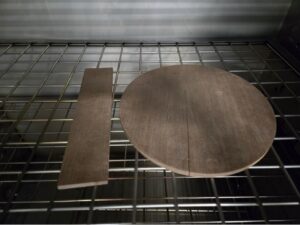
Check out a video of the laser engraving process here.
Do the records really play? Check it out for yourself.
After engraving, every record was played once on a turntable in ceremonial fashion, start to finish, before it joined the whiskey inside the barrel.
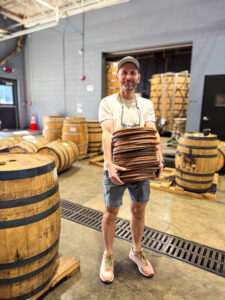
Making the Whiskey
Before any of it went near a record, Bad Chattanoogan was designed as a Tennessee Whiskey to the core – or more accurately, Tennessee Whiskeys – plural.
The concept began with 3 high malt Tennessee Whiskey mash bills, all built from primarily Tennessee-grown corn, wheat malt, and barley malt. To give our distillers a broad palette for blending, the 3 recipes varied in both grain and distillation method: 2 were pot distilled, 1 was column distilled, 2 were wheated, and 1 even included 15% Tennessee-grown maple-wood-smoked wheat malt — bringing maple into the whiskey before it was ever distilled.
After each recipe was distilled, every drop was mellowed through sugar maple charcoal for more than 24 hours – known as the Lincoln County Process. From there the whiskey aged more than 4 years in a combination of charred & toasted and charred oak barrels – much of it Tennessee-grown oak.
Mash Bill #1: Pot Distilled
68% TN Yellow Corn
15% TN Pilsner Malt
13% Munich Rye Malt
4% Honey Malt
Mash Bill #2: Pot Distilled
65% TN Yellow Corn
20% TN Pilsner Malt
15% TN Maple Wood Smoked Wheat Malt
Mash Bill #3: Column Distilled
64% TN Yellow Corn
21% TN Wheat Malt
15% TN Pilsner Malt
The Music
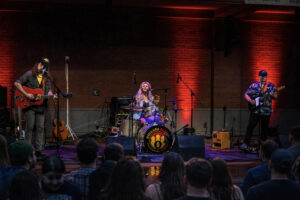
But Rich’s part-time gig is… gigs.
A longtime fixture in Chattanooga’s music scene, Rich has worn just about every hat imaginable: music blogger, show promoter, songwriter, and frontman of bands including Eight Knives, General Dollars, and now Dollars Family.
Rounding out the trio are Jennifer Brumlow and Callie Harmon, formerly of Rye Baby, a Chattanooga duo known for their rowdy mix of garage rock, surf, rockabilly, and good old-fashioned twang.
Together, the three make up Dollars Family — the Chattanooga band whose music is engraved onto the wooden records that finished Bad Chattanoogan.
On Side A, there’s “Bad Chattanoogan,” written specifically for this project as a tribute to the characters, creators, and independent spirits who make Chattanooga anything but ordinary. From hometown icons like artist Wayne White, actor Samuel L. Jackson, and blues legend Bessie Smith to the makers, shakers, and go-getters keeping this city interesting today, it’s a celebration of the people who give Chattanooga its personality.
On Side B, there’s “City I Love,” a song already part of Dollars Family’s catalog and an ode to the place they call home.
Two different songs, one shared inspiration: Chattanooga and the people who make it what it is.
Together, they became the two sides of our first Tennessee Whiskey — each blend finished on playable wooden records engraved with its corresponding song.
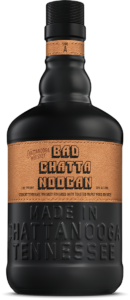
Side A Blend – “Bad Chattanoogan”
Blend: Mash Bill #1: 50%, Mash Bill #2: 6%, Mash Bill #3: 44%
Age: Greater than 4 Years
Proof: 100 (50% Alc/Vol)
Cooperage: Toasted & Charred Oak Barrels, 44% TN Oak
Batch Size: 9 Barrels
Finishing: 1 month with 15 maple wood records engraved with the song “Bad Chattanoogan”
Tasting Notes: Sweet tea, banana bread, chocolate covered dried cherry, and toasted maple granola
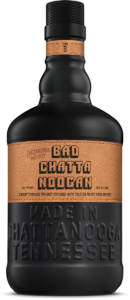
Side B Blend – “City I Love”
Blend: Mash Bill #1: 0%, Mash Bill #2: 56%, Mash Bill #3: 44%
Age: Greater than 4 Years
Proof: 100 (50% Alc/Vol)
Cooperage: Toasted & Charred Oak Barrels, 89% TN Oak
Batch Size: 9 Barrels
Finishing: 1 month with 15 maple wood records engraved with the song “City I Love”
Tasting Notes: Smoked apple crisp, crème brûlée, dark brown sugar, toasted walnut, and mulling spices
The Bottles
And for those searching for Easter eggs, the bottle itself rewards an even closer look. Hidden in the details are various nods to Chattanooga including: a notorious wallet carried by Chattanooga-native Samuel L. Jackson, an inaugural ticket to the old Chattanooga Lookouts baseball stadium, a $3 note from the Bank of Chattanooga, and the first lottery ticket ever sold in Tennessee, bought at Steve Ray’s Midnite Oil in Ooltewah, TN.
Finally — to literally top it off — each bottle is closed with a vinyl-inspired wood topper, engraved with the iconic 45 rpm adapter symbol (the speed at which the wooden records spin) and a magnified section of the actual engraved grooves from “City I Love.”